Laksa

Showing posts with label Laksa. Show all posts

Wednesday, 21 October 2020

Fish Assam Laksa Recipe | Laksa Asam Ala laksa Penang & Laksa Kedah


 It's been quite some times since I make assam fish laksa, or called laksa asam in Malay.

Actually, we have a few versions of assam laksa here which each version has it's own signature.

Singaporean curry laksa is one of the coconut based curry laksa which is so popular among Singaporean and is one of Nyonya's signature dish.

This laksa is absolutely delicious with thick and creamy laksa gravy!


Check on my previous post for Singaporean curry laksa recipe here:


https://thelynalina.blogspot.com/2020/02/singaporean-curry-laksa.html


AND


https://thelynalina.blogspot.com/2019/03/laksa-singapura-aka-singaporean-curry-laksa.html (for Malay version of the recipe)


Alright, back to our topic earlier about assam laksa.

The most well-known assam laksa, which is not only adored by Malays but also to other races here are penang assam laksa and Kedah assam laksa.

Actually, the taste of these laksa is slightly different from each other - but since I'm not really a fan of assam laksa, so, I can't really tell the differences.

I learnt to make assam laksa from my mom, and now I made this assam laksa to satisfy her craving for one of her favorite dish.


I tripled the portion for the gravy to be enjoyed until the next day.

The gravy is more delicious, thick and savory after reheated.  

Trust me!

To make the fish gravy, You'll need fresh mackerels (ikan kembung), or ikan selayang, but I prefer to use mackerels for my assam laksa gravy.

The fishes are cleaned thoroughly until the strong fishy smells of the fishes disappear.

You can wash your fishes with lime water (air kapur), salt water or tamarind paste water to remove the fishy smell.

I've been using CNI food wash for years to wash my fish, meat and veges, but when I ran out of stock of the food wash, I'll use lime water to wash my fish and meat.

In this recipe, I added canned sardines which I chunked using a fork into the gravy to add more flavor, textures and thickens the gravy.

Some recipes called for using three types of onions - onion (bawang besar), garlic and shallots (bawang kecil).

I prefer to use onion only, blended until smooth together with dried red chilies and toasted shrimp paste.

I have tried adding shallots and garlic before to make my assam fish gravy, but I still prefer of using onion alone.

You can try adjusting the ingredients until you get your desired gravy flavors.


To watch my video for step-by-step tutorials in making fish assam laksa recipe, you can watch it here:


Even though I didn't meticulously count the calories amount for this dish, I have to say that this version of assam fish laksa is still has much fewer calories compared to laksa lemak (coconut based laksa gravy) like SIngaporean curry laksa, laksam (Kelantanese laksa of origin) and laksa Johor.

This laksa is oil-free, and the best part is - you just need to dump in all the ingredients and simmer until the gravy is thickened and that's it! 

A delicious, aromatic and flavorful gravy!

One bowl is never enough! 

For me, the only undesired part when making assam fish laksa is to debone the fish!

It's a tedious process that exhaust my energy since I have to invest all my focus into ensuring that not a single bone is left attached to the fish flesh!

Ohh! How I wish I can at least enjoy doing the fish deboning task.


Alright! Let's go through the details of this recipe down below.


FISH ASSAM LAKSA 


Category : Laksa

Serving Size : 10 to 12 people

Preparation Time : 15 minutes

Cooking Time : 1 hour and 30 minutes


INGREDIENTS:


Gravy:


3 mackerels (about 600 grams) 

1 large can of sardine - remove the gravy

3 onions - cut into chunks

8 cm of toasted shrimp paste (I used Melaka shrimp paste)

20 pieces of dried red chilies

1 liter of water (to boil the mackerels)

800 ml of water (to blend the spices)

1 liter of water (to blend the fish bones)

1 liter of water (to dilute the gravy)

A handful of laksa/kesum leaves

2 torch ginger - halved

6 to 7 tamarind slices

Salt to taste

Sugar to taste


Other Ingredient:


1 to 2 packets of laksa noodles


Garnish:


Onion (I used Holland onion) - sliced

Cucumber - julienned

Limes - halved

Boiled eggs - halved

Salad - chopped

Green bird's eye chilies - sliced


INSTRUCTIONS:


To Prepare Laksa Gravy:


Clean the fish thoroughly until the strong fishy smell disappear. 


Boil the fish with 1 liter of water over high heat for about 10 minutes, until the fishes are cooked through.  Remove the fishes and place on a plate.  Set aside to allow the fishes to turn warm, or until you can handle the fish with your hand.

When the fishes turned warm, carefully separate the flesh from the bones.  Strain the fish stock and blend with the flesh.  

Then, blend the fish bones with 1 liter of water and strain with a fine mesh strainer.


To prepare for the spices.  Slit open dried red chilies by using a scissor  and toss to remove some of the seeds. Skip this step if you prefer your laksa gravy to be spicier.  Boil dried red chilies until soften and strain.  Cut onions into large chunks and put in a blender.  Add softened dried red chilies and toasted shrimp paste and blend finely with 800 ml of water.  
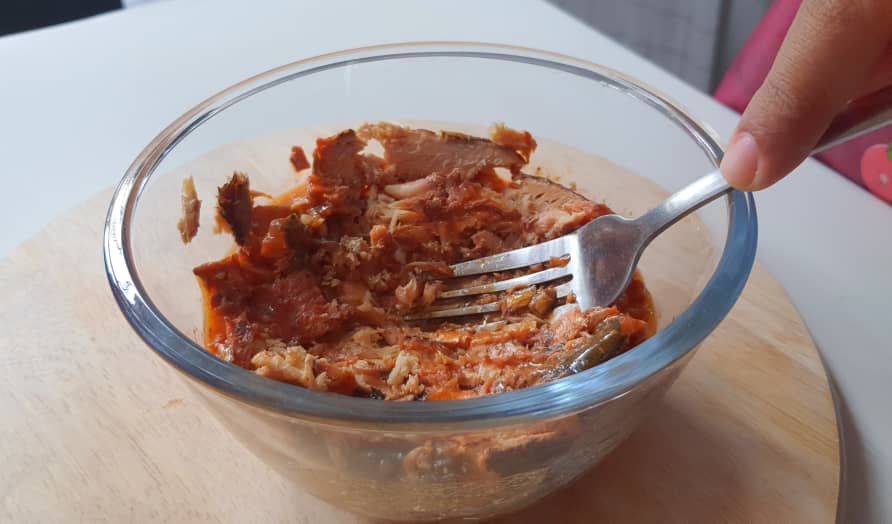


Coarsely mash sardines with a fork.


Pour in blended spices, mashed sardines, blended fish flesh, strained fish bone stock and add another 1 liter of water (please adjust accordingly) and bring the gravy mixture to boil.


Add kesum/laksa leaves, torch ginger and tamarind slices.  Simmer the gravy over medium to low heat until it thickens to your desired consistency.

Lastly, season your laksa gravy with salt and sugar to taste.


To Prepare Laksa Noodles:


Soak laksa noodles (if you're using instant, dry laksa noodles) for 1 hour, or until the noodles are no longer stiff.

Strain the noodles.

Bring water to boil in a large pot.  Then, boil strained laksa noodles with 1/2 teaspoon of salt for 15 to 20 minutes over medium heat, or until noodles are soft but are still chewy.

Strain the noodles. 


To Assemble Assam Laksa:


Place some noodles in a bowl.  Pour gravy over the noodles and top with julienned cucumber, chopped salad, sliced bird's eye chilies, sliced onion, boiled egg and lime.

Serve immediately.


Friday, 21 February 2020

Mee Kari Kerang/ Malaysian Curry Noodles


Curry noodles is a popular dish.
It is a signature dish especially among Malaysian, Indonesian and Singaporean.
Japanese has their famous udon curry, which taste slightly different, mild and sweeter.
Here in Malaysia we have a few variations of curry noodles, or mee kari - we have cockles curry noodles (mee kari kerang), seafood curry noodles - with shrimps and squids, beef, chicken and fish curry noodles.
The curry noodles have similar method in the preparation of the gravy, but the taste will vary according to whether you are using chicken, beef, fish, cockles or seafood.
AND...the best thing is, there's no fix rules in making curry noodles, and you're free to mix and match the meat options to suit your preferences.

Since seafood is not regular at our home, usually my version of curry noodles use chicken as the main ingredient.
Chicken is a versatile seasoning, and it is suitable for almost with any kind of dishes, so..chicken is a must have ingredient available in my freezer.


I have googled curry noodles recipes - some of the recipes are using empat sekawan (cinnamons, star anises, cardamoms and cloves) while some of the Nyonya's versions of curry noodles has fish and soy sauce added into it.
For me, what makes the gravy of curry noodles special and different with the regular curry that we prepared to be paired with bread and rice is the usage of lemongrass and galangal.
While adding lemongrass and galangal added more flavor in regular curry, however, there two ingredients are not necessarily be added since regular curry is already scrumptiously flavored with curry paste, onion, ginger, garlic, coconut milk, curry leaves, and not forgetting - the empat sekawan.
So, if you're a fan of curry, it's worth to try and experimenting to make the best curry noodles gravy that suits your taste.

I learned to cook local dishes such as curry noodles, mee rebus (a noodles dish with sweet potato gravy), laksa Johor and the popular mee bandung Muar from my mum.
She is expert in preparing these dishes especially when she was young.
Half of my cooking skills I got it from my mum.

I made curry noodles yesterday, and usually, I 'll cook in a larger portions to be eaten until the next day.
Some dishes, like rendang, curry, asam pedas and laksa gravy - they taste better the next day after reheated.
The proteins in meat are be broken down into smaller molecules will enhance the flavor of the dish and the spices from onion, garlic, ginger and curry powder will make the dishes more savory and well-rounded with flavors when reheated.

Another ingredients you need to consider adding to your curry noodles are fish balls, fish cakes and tofu puff.
Every time when I decided to cook curry noodles, I will make sure I have these three ingredients at home.
It's not a necessity, but adding fish balls, fish cakes and tofu puff will really makes a difference.
It's like the make up of the dish that will make your curry noodles more appetizing and flavorful.

If you're using shrimps to make the noodle's gravy, you can use the the head and the shrimp's shells to prepare the shrimp broth (or stock).
 My easiest way to make plain shrimp broth is to cook the shells with water and when the mixture is boiled, lower the heat and allow it to simmer for another few minutes.
Strain the mixture to remove the shells into a clean container.
It can lasts up to 3 days when refrigerated.
Alternatively, you can also prepare beef stock by simmering the bones (with some scraps of meat attached to the bones) to extract its flavor.
Additional onion, garlic, celery and carrot may also be added to prepare the both the shrimp and beef stock.

To remain its authenticity, I used yellow noodles, parboiled until tender (not mushy) and strained to remove excess the water to be eaten with the noodle's gravy.
I know yellow noodles may cause stomach boating and cramp to some people as it does contains lye water for alkalisation of the noodles that gives its chewy texture and yellowish color.
I sometimes develop these symptoms since I have a sensitive stomach.
So, the other options you can enjoy your curry noodles are to substitute the yellow noodles with bee hoon (rice vermicelli), kuew teow (flat rice noodles) or egg noodles.


MEE KARI KERANG
(MALAYSIAN CURRY NOODLES)


Cuisine : Malaysia, Nyonya, Singapore, Indonesia
Serve : 7-8


Ingredients for making the noodle's gravy (*not in picture : tofu puff)


Ingredients:

1/3 chicken - cut into small parts
1 cup of cooked, unshelled cockles - optional
1 lemongrass - bruised
4cm of galangal - bruised
150 ml or 3/4 cup of coconut cream
1 1/5 liter of water
5 tablespoons of meat curry powder (mix with 1/3 cup of water to make curry paste)
3 tablespoons of chili paste - optional
1 cube of chicken stock or 1 tablespoon of chicken stock powder - optional
1 small packet of fish balls (I used 10 large fish balls)
1 small packet of fried fish balls - optional
2 sticks (or more) of fish cakes
1 small packet of tofu puff - cut into 4
Approximately 5 tablespoons or 1/4 cup of cooking oil
Salt to taste
Sugar to taste


 Ingredients (to blend):

6 shallots (or more if you're using the smaller size)
1 onion
4 cloves of garlic
1 inch of ginger


Garnish:

1 to 2 packets of 500 grams of yellow noodles
Fried hard tofu - sliced
Hard-boiled eggs
Chinese celery - chopped
Fried shallot
Spicy  chili paste


Methods:

  1. Heat oil in a large pot over medium heat.  Stir fry the blended mixture and chili paste until fragrant.  Then, add in curry paste and cook until the oil separates and the mixture turned dark orange.
  2. Pour in water, add chicken parts, bruised lemongrass and galangal, chicken stock cube/powder and season with sugar and salt.  Bring the mixture to boil.
  3. Add in fish balls, fish cakes, fried fish balls, tofu puff and cockles (if using).  Remove the fish balls, fish cakes and fried fish balls with a tong once they float on the gravy's surface.
  4. Pour in the coconut cream, lower the heat and allow it to simmer until the gravy is slightly thickened.
  5. In another pot, bring water to boil over medium heat.  Add a teaspoon of salt and add noodles.  Stir noodles from the bottom from time to time and cook until barely done.  Take note not to cook the noodles until mushy.  Drain parboiled noodles in a colander and rinse at once under running water to remove excess starch.  Place the noodles in a large container or plate and set aside until needed.


To Prepare The Spicy Chili Paste


Ingredients:

10 tablespoons (or more) of chili paste
Salt to taste
Sugar to taste
Cooking oil

Instructions:

Heat oil in a pan or saucepan, fry chili paste, add sugar and salt and cook until the oil is separating and the mixture turned dark red.


To Assemble Curry Noodles:

Place a portion of parboiled noodles in a serving bowl, pour in the gravy and garnish with sliced fried tofu, sliced fish cakes, fish balls, hard-boiled egg cut into half and sprinkle with chopped Chinese celery and fried shallot.

Serve immediately with spicy chili paste.


Monday, 3 February 2020

Singaporean Curry Laksa


Hello 2020!

This is my first blog post for this year, after a hectic weeks of baking for my cookies orders for CNY.
This year I was more excited in creating my new cookies collections, to add more varieties for my customers on top of my best selling open faced pineapple tarts!

We have just started changing our eating pattern, by practicing intermittent fasting.
Keto and Atkins doesn't seem to work on both of us, and these two diets required more time to meal preps and redesign our regular menus to be less carbs or more protein based.
And to cut off any of the food group isn't at my best interest right now, instead, we prefer to control our portion and eat in moderation.

I hope this year I can share a lot more delicious recipes for my readers.
Cooking is my hobby, while creating new recipes is my passion.

Today, I'm excited to blog about my first recipe for this year, that is Singaporean Curry Laksa.
I've blogged about Singaporean Curry Laksa or Laksa Singapura before, but in Malay.
Here's the link of my previous Singaporean curry laksa recipe:  https://thelynalina.blogspot.com/2019/03/laksa-singapura-aka-singaporean-curry-laksa.html

I'm indeed surprised that my blog post for laksa Singapura is among the top five entry in Google despite of being a new blogger in this field.  Alhamdullillah..

This recipe is not much different from the previous recipe I've shared.
I used fresh red chilies in this recipe, instead of blended dried chilies in my previous Singaporean curry laksa recipe.
Shimp paste, or we called as "belacan" in Malay is one of a significant ingredient in making laksa, especially Laksa Johor, Laksa Kedah, Laksa Penang and Laksa Singapura or Singaporean Curry Laksa.
Addition of shrimp paste, along with fresh shrimp strengthen the flavor of the laksa gravy.
You may omit shrimp paste and add more fresh shrimp instead like in this version of my Singaporean curry laksa recipe.
I didn't use shrimp paste and kerisik or coconut paste in this recipe, but it's still taste delicious and awesome!
Singaporean curry laksa has now officially become one of our top favorite dish, and it 'll taste better after you reheat the laksa gravy.

As for the laksa's noodles, you may choose to eat with spaghetti or thin rice noodle, or bihun, instead of the regular rice flour laksa noodles or laksa beras.
But for us, we prefer to have our Singaporean curry laksa with the regular laksa beras, the dried version, that needs to be soaked first before boiled.
To add more flavor, I would recommend to add anchovies powder into your laksa gravy

Alright, without wasting more time, so..here is the nitty-gritty of the recipe:


SINGAPOREAN CURRY LAKSA

Cuisine: Singapore/ Malay/ Nyonya
Serve: 7-8


Ingredients:

4 large sized mackerel/ 6 medium sized
300 grams of shrimp (medium/large sized)
1 packet of tofu puff - cut into 2
1 small packet of fried fish balls
1 small packet of fish balls
1 packet of fish cakes
250ml coconut cream (I used KARA brand)
2 ginger torch (bunga kantan) - stalk removed and cut into 2
A handful of laksa leaves (daun kesum)
1 anchovies cube/ 2 tablespoons of anchovies powder - optional
3 slices of asam gelugor - adjust accordingly
2 tablespoons of coconut paste (kerisik) - optional
Salt to taste
Sugar to taste
4 tablespoons of fish curry powder - mix with 1/2 cup of water to make curry paste
2 1/2 liters/ more of water - adjust accordingly
1/4 to 1/3 cup of cooking oil


Ingredients to Blend:

6 shallots (or more depending on the size)
5 garlic
2 onions
4 red chilies
1 inch of shrimp paste - optional
2 tablespoons of dried shrimp
2 lemongrass  - thinly sliced
4cm of galangal (lengkuas)
Water for blending the ingredients


Other Ingredients:

1 packet of rice flour laksa noodles - soak and cook according to instructions provided.
hard boiled eggs - sliced
cucumber - julienned
bean sprouts
Calamansi lime (limau kasturi)
Long beans - thinly sliced
Basil leaves - chopped (optional)


Instructions:

  1. Clean the fish thoroughly.  Bring 1 liter (or more) water to boil in a large pot or a shallow pan.  Add 1 teaspoon of salt to the boiling water and add in the cleaned fish and boil for approximately 10 minutes or until the fish flakes easily.  Remove the fish from the wok and let the fish slightly cool before flaking it.  Blend the fish flakes until smooth, set aside. 
  2. Remove the heads and the shells of the shrimps and boil the shells using the fish stock for 10 minutes.  Add more water if necessary.
  3. Strain the fish stock to remove any fish bones and shells and set aside. (We will use the stock for the laksa gravy).
  4. Heat oil in a large pot.  once hot, add in blended mixture and curry paste and cook until the oil separate and fragrant.
  5. Pour in the stock and the remaining water.  Add in anchovies powder/cube, laksa leaves, ginger torch, blended fish flakes, coconut paste (if using) and asam gelugor.  Bring it to boil under medium heat.  Season with salt and sugar.
  6. Add in fish balls, fish cakes, shrimps and tofu puff and cook until the fish balls and fish cakes float on the surface and the shrimps turn whitish.  Remove the fish balls, fish cakes and the shrimps into a bowl.
  7. Lastly, add in coconut cream or coconut milk and simmer under low heat until the gravy reach your desired consistency.
  8. To assemble a bowl of Singaporean curry laksa for serving, cut fish balls into two or four and slice fish cakes diagonally, put some of the boiled laksa noodle in a serving bowl, pour the laksa gravy using a ladle and top with sliced fish cakes, fish balls, two to three shrimps, sliced boiled egg, julienned  cucumber, bean sprouts (if using), half of Calamansi lime and sprinkle with chopped basil leaves (if using).  Serve immediately.


Tuesday, 19 March 2019

Laksa Singapura a.k.a Singaporean Curry Laksa


Assalamualaikum...


Hari ni Lyn akan kongsikan resepi laksa Singapura yang Lyn dan hubby buat petang semalam.  Ini lah kali pertama Lyn masak laksa Singapura, sebelum ni selalu Lyn akan masak laksa Johor, which is our favorite laksa of all time and then laksa sardin, ala-ala laksa Kedah tu.  Sebab utama yang mendorong Lyn nak cuba sangat memasak laksa Singapura ni ialah lepas Lyn terjumpa Youtube video family Datuk Aaron Aziz memasak.  Isteri Datuk menyediakan laksa Singapura manakala anak-anak mereka masing-masing menyediakan spagetti Bolognese muffin blueberry dan jus air.  Memang seronok je melihat gelagat mereka anak beranak tu, happy family! Hehe..

Tanpa membuang masa, Lyn pun terus gigih menggoogle resepi laksa Singapura ni.  Ada macam-macam variation tentang penggunaan bahan-bahan untuk membuat laksa Singapura ni rupenya.  Ada yang tak letak ikan, ada yang letak stok ayam dan macam-macam variasi lagi.  Lyn pun confused kejap tak sure nak follow resepi mana.  Tapi akhirnya, Lyn cuba ikut resepi dari Datin Diyana Halik, yang menggunakan ikan kembung dan udang sebagai perencah utama.  Sebenarnya kalau tengok balik resepi yang dipakai untuk membuat laksa Singapura ni tak jauh beza dengan laksa Johor pun.  Cuma kalau laksa Johor, biasanya Lyn tak letak lengkuas dan udang basah dikisar halus seperti isi ikan.  Fish cake dan fish balls takde kalau kat laksa Johor.  Lepas tu, trademark laksa Johor lagi satu yang takde pada laksa Singapura ialah sambal belacan.  Hehe...orang Johor memang suka makan pedas, betul tak? Sambal belacan mesti kena ada!


Dalam video yang Lyn tonton tu, Datin takde la bagi tau spesifik berapa banyak anggaran untuk setiap bahan, jadi Lyn pandai-pandai lah sendiri.  Semalam kebetulan my hubby off day, apa lagi terus recruit dia jadik assistant chef kat dapur.  Maklum la, penyediaan untuk membuat laksa Singapura ni kan agak renyah, banyak persiapan yang perlu dibuat.  Semua bahan-bahan untuk membuat laksa Singapura ni Lyn berjaya dapatkan cuma buah keras pulak yang tertinggal!  Anyhow, walaupun takde buah keras, alhamdulillah kami sangat berpuas hati dengan kejadian laksa Singapura kami ni.  Jom kita semak resepi.

Resepi Laksa Singapura a.k.a Singaporean Curry Laksa

Bahan -bahan:

1/2 kg ikan kembung (rebus, buang tulang dan kisar halus)
1/2 kg udang putih besar (kepala dan ekor direbus untuk buat stok udang)
1 kuntum bunga kantan (belah 2)
segenggam kecil daun kesum
1 keping asam keping
1 1/2 kotak kecil santan (Lyn pakai KARA)
1 kiub ikan bilis
3 liter air
1 peket fish ball
1 peket fish ball goreng
3 batang fish cake
1 peket kecil tofu puff'
3 sudu besar rempah kari ikan (bancuh dengan air jadikan pes)
garam
gula
3 sudu besar kerisik
5 sudu besar cili kering kisar
minyak untuk menumis
1 peket laksa beras

Bahan kisar:

10 ulas bawang merah
1 biji bawang besar
5 ulas bawang putih
sedikit belacan
3 sudu besar membukit udang kering (rendam dulu)
3 batang serai (hiris nipis)
4 cm lengkuas 
2 inci kunyit

Bahan sampingan:

taugeh (bersihkan ekor)
timun (hiris nipis memanjang)
telur rebus
limau kasturi
sambal belacan (optional)
daun selasih (optional)
kacang panjang (optional)

Cara Penyediaan:

  1. Kisar halus bahan kisar.  Panaskan minyak dalam periuk, tumis bahan kisar dan cili kisar hingga agak garing, kemudian masukkan pes kari ikan dan tumis hingga pecah minyak.
  2. Masukkan air, diikuti dengan bunga kantan, daun kesum, kiub ikan bilis, asam keping, ikan yang dah dikisar halus dan stok udang.  Reneh hingga mendidih.
  3. Bila dah mendidih, masukkan pula kerisik, udang, fish ball, fish cake dan tofu puff.  Reneh sebentar dan masukkan santan kotak.  Biarkan kuah menggelegak dengan api yang sederhana.  Akhir sekali perasakan gula dan garam.
  4. Untuk laksa beras, rendam dahulu laksa kira-kira 30 minit atau mengikut peraturan yang disediakan di plastik pembungkus, kemudian rebus dalam air yang mendidih dan campurkan sedikit garam.  Toskan dan sedia digunakan.

#NOTA#

Kalau rajin boleh tumbukkan segenggam kecil ikan bilis dan campur ke dalam kuah.  Lyn pakai kiub ikan bilis je.  Kenapa kena letak perasa ikan bilis? Ianya akan menambah rasa lemak pada kuah laksa ni.  Ni petua bonda Lyn kalau nak buat laksa Johor.  Tapi similar jugak la dengan laksa Singapura ni.

Kalau anda buat mengikut sukatan bahan-bahan seperti yang Lyn tulis di atas ni kejadiannya banyak, boleh hidang untuk 10 ke 12 orang makan.  Jadi, kalau nak buat untuk family kecil je, kurangkan la sukatan tu.

Mana-mana kuah laksa makin dipanaskan makin sedap dan pekat.  Jadi jangan risau, kuah laksa ni kalau tak habis makan boleh masuk dalam tupperware dan simpan je dalam freezer.  Bila nak makan panaskan je balik.

Warna kuah laksa Singapura ni light dan kekuningan sikit berbanding kuah laksa Johor sebab penggunaan rempah kari yang sedikit dan campuran kunyit hidup yang dikisar halus.